Growing Patterns: Fibonacci Numbers in Nature
 Author: Sarah C. Campbell
Illustrator: Richard P. Campbell
Genre: Non-Fiction
Grade level: 1-4
Author: Sarah C. Campbell
Illustrator: Richard P. Campbell
Genre: Non-Fiction
Grade level: 1-4
Growing Patterns: Fibonacci Numbers in Nature is a non-fiction book about mathematical patterns found in nature. This book is actually quite interesting because it shows pictures of this pattern that can be seen repeatedly throughout many different plants, animals, and even objects found in nature. This pattern is a sequence of numbers where each number is the sum of the two numbers that come before it.
The illustrations are photographs taken by Richard P. Campbell. The images show the mathematical pattern that can be found in any natural spiral. These photographs of daisies, pinecones, shells, and more allow the readers to see natural patterns from a new perspective.
A teacher could use this book in the classroom in many different ways. It is a great example of a non-fiction informative text. It is also a great introduction and a new perspective at looking into patterns. This could also be used when introducing the wonders of nature. I would suggest this book for a little bit of an older reader because this information could go right over a five year old's head.
The Day-Glo Brothers: The True Story of Bob and Joe Switzer's Bright Ideas and Brand-New Colors
Author: Chris Barton
Illustrator: Tony Persiani
Genre: Non-Fiction
Grade level: 2-5
Award: Robert F. Sibert Medal
The Day-Glo Brothers is a true story about two brothers, Bob and Joe Switzer. They are very different brothers in that Joe wants to be in show business and Bob wanted to be a doctor. When Bob gets in an accident that has him staying in a dark basement, the brothers experiment with florescent paints and ultraviolet lights to brighten up the place. They end up creating something totally different, Day-Glo paint.
Tony Persiani created really cool illustrations in Day-Glo paint, which is totally appropriate for this book. The colors and the drawing style have like an old time cartoon style, which is great because it is a story about something that happened in the past.
This book would most interest students who range in age from about seven to ten. This is an interesting story and a topic that they may have never heard of before. Students always hear stories of people who invent things having intent to invent them, but rarely do they hear of accidental inventions.
Bubble Homes and Fish Farts
 Author: Fiona Bayrock
Illustrator: Carolyn Conahan
Genre: Non-Fiction
Grade level: 1-3
Author: Fiona Bayrock
Illustrator: Carolyn Conahan
Genre: Non-Fiction
Grade level: 1-3
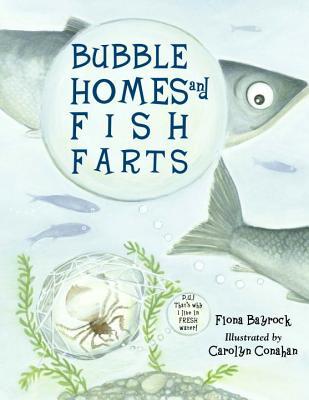
Bubble Homes and Fish Farts is an extremely fun non-fiction book about how different animals use bubbles in interesting ways. From a water spider building a bubble home under water to dolphins play a game with bubble, it can be seen that many animals use bubbles in ways people may not know about.
The illustrations by Carolyn Conahan are beautiful drawings made with mainly shades of blue and green since most of the pictures are in an under water setting. The illustrator was also clever in giving the animals speech bubbles provided the animal's point of view. They bring a really humorous aspect to the book.
Although, the title is questionable, the book is extremely interesting. This book is great when introducing animals that live in the water in science because it blends facts with humor in a way that will be interesting to young students. It includes facts about habitats, scientific names, survival, and adaption of animals.
Bugs and Bugsicles: Insects in the Winter
 Author: Amy H. Hansen
Illustrator: Robert C. Kray
Genre: Non-Fiction
Grade level: 2-5
Author: Amy H. Hansen
Illustrator: Robert C. Kray
Genre: Non-Fiction
Grade level: 2-5
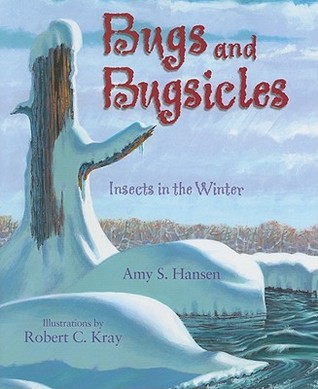
This book is a non-fiction texts that teaches students about insects in the winter months. Insects leave in the fall and magically return in the spring it seems. This book unveils the secrets of how bugs survive the winter season.
The illustrations are created by Robert C. Kray, and recreate the insects to show how they move from place to place and how they look during these cold winter months. He paints these pictures in acrylic to cause the pictures to look very realistic and almost three-dimensional.
This book contains lots of great information that would be very fascinating for students to learn. This information presents students with scientific data that could otherwise be taught to them in a boring approach. This topic is really never covered for students, and this book gives really interesting facts as well as science experiments in the back of the book.
Moonshot: The Flight of Apollo 11
 Author/Illustrator: Brian Floca
Genre: Non-Fiction
Grade level: 2-5
Author/Illustrator: Brian Floca
Genre: Non-Fiction
Grade level: 2-5
Moonshot: The Flight of Apollo 11 is a picturebook about the first moon landing. This book features the astronauts getting ready to take off by getting their gear on and then sitting in their sideways seats. It shows all of the machinery and gives details of the rocket's parts. This is a story of adventure and discovery shown from a whole different perspective than young readers are used to.
The illustrations were created by the writer as well, Brian Floca. The pictures are very detailed and keep the readers' attention and compliment the texts very well. The front and back cover have very attention grabbing illustrations as well as information about launching and lift off.
I would suggest this book for students who are seven to eleven years old because that is when children should become more interested in non-fiction books. This non-fiction book is great because although it is very informational, it comes off as a story and is very entertaining for young readers.

